
In the last six months several independent, physician-led practices have opened, including Sorelle Health (gynecology), Voci Breast Surgery (breast surgery) and The Eastover Clinic (dermatology).
- These specialty providers have bucked the traditional health insurance model, opting for direct-pay care.
The broader picture: People with discretionary income are shifting away from flashy labels and reinvesting in the things other people can’t see: hobbies that bring them joy, boutique healthcare and being chronically offline.
The shift: It’s no longer about seeing the doctor when there’s an issue; it’s about feeling your best and being proactive about health.
Consumers are also getting pickier about their care—and they’re willing to pay more for it.
- “They value access, time, communication, and a relationship with someone they trust,” says Dr. Amy Voci, owner of Voci Breast Surgery.
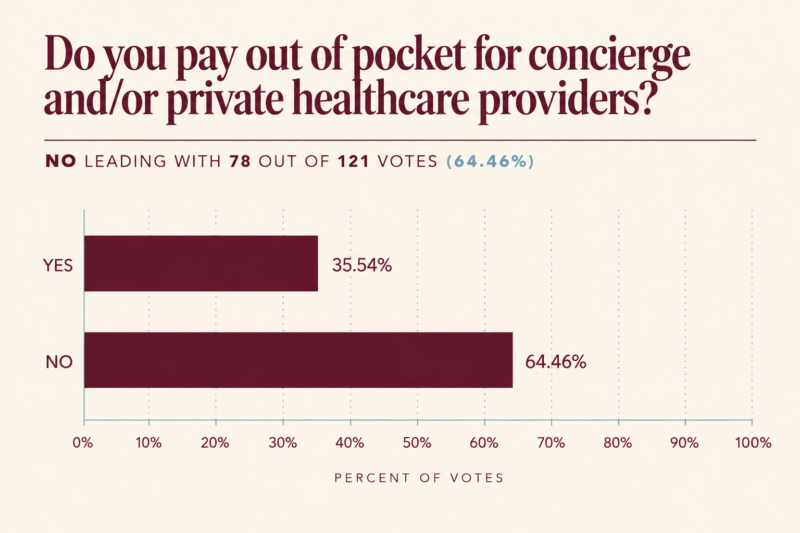
Data show: Roughly 46% of Scoop readers pay out of pocket for concierge and/or private healthcare.
Survey says:
- “I do it and at the same time it kind of makes me queasy that I do; however, I never have trouble getting to a medical professional for anything big or small… the current state of medical practices and our hospital systems are sad and not patient focused.”
- “I don’t pay for these extra services today, but I did pay for it for one year when my twin daughters were born (in 2022). I felt like it was worth every penny!”
- “The older I get the more things can go wrong. My husband has done it for years. I just recently signed up. It takes so much stress out of maintaining my good health. We both feel it’s well worth it.”
- “Concierge healthcare is both a luxury and an investment.”
- “I wish I could but I can’t afford it.”
- “No. I’ve been thinking about it though when I leave corporate!”
- “Best thing I’ve done.”
The move: All four providers I spoke with transitioned to this model to spend more time with each patient and come up with a more individualized, holistic plan for care.
For Dr. Emily McLean: “Simply put, I believe practicing outside the traditional insurance-based model allows me to be a better doctor,” The Eastover Clinic owner says.
- She loves being able to say “bring the list,” and knock out all their dermatology questions in one visit—from mole checks to cosmetic skincare.
For Dr. Heather Graham and Dr. Frances Yancey: “Being a direct-pay practice allows us to offer longer appointments, see fewer patients each day, provide transparent pricing, and focus our time on listening, educating and creating individualized treatment plans,” the Sorelle Health founders say.
- “We didn’t set out to build a busier practice. We set out to build a better one.”
For Dr. Voci: “I can coordinate with the radiologist, medical oncologist, radiation oncologist or plastic surgeon who is best for that individual patient rather than having care defined by one health system.”
The business case: The private model is leaner, which oftentimes makes operations simpler and cheaper, too.
- “I wanted to build a practice that could be sustainable for the long term without solving that equation by simply seeing more and more patients in less and less time,” Dr. McLean says.
The pushback: “When someone hears private or fee-for-service, it can sound exclusive. My goal is actually the opposite: access. Cancer doesn’t wait, and neither should a patient,” Dr. Voci says.
Bottom line: Expect to see more doctors-turned-founders in Charlotte as demand grows.